

University AV gets refreshed every three to five years. The furniture in that same room lasts fifteen or more. That's not a procurement oversight. It's a design problem, and it has a design solution.
Look at how fast the brief has changed. In 2019, a state-of-the-art classroom meant a ceiling-mounted projector, a fixed instructor podium, rows of tablet-arm chairs, and a few outlets along the wall. Today that same room needs wide-angle cameras for hybrid teaching, microphone arrays, multiple displays for sharing content at once, and power at every seat. By 2029, it'll need infrastructure nobody can name yet.
That's the tension every higher eduction facilities director and campus planner is sitting with right now: the furniture you buy this year has to serve teaching technologies that don't exist yet. A room furnished in 2025 will still be in use in 2040. Computing turns over every three to five years, AV every four to seven, but classroom furniture sticks around for fifteen to twenty-five. It outlives three or four generations of technology before anyone retires it.
The usual fix is to over-build the infrastructure: run cable everywhere, pack in floor boxes, and hope future systems fit. It's expensive, disruptive to install, and often wrong anyway. The better fix is furniture strategy: specifying and configuring rooms that absorb technology change without getting torn out every time the tech turns over. And it's not just about protecting budget. It's about protecting the people in the room: faculty who want to teach the way their field is evolving, and students whose learning depends on a space that keeps up.
The Active Learning Shift That Rewrote the Brief
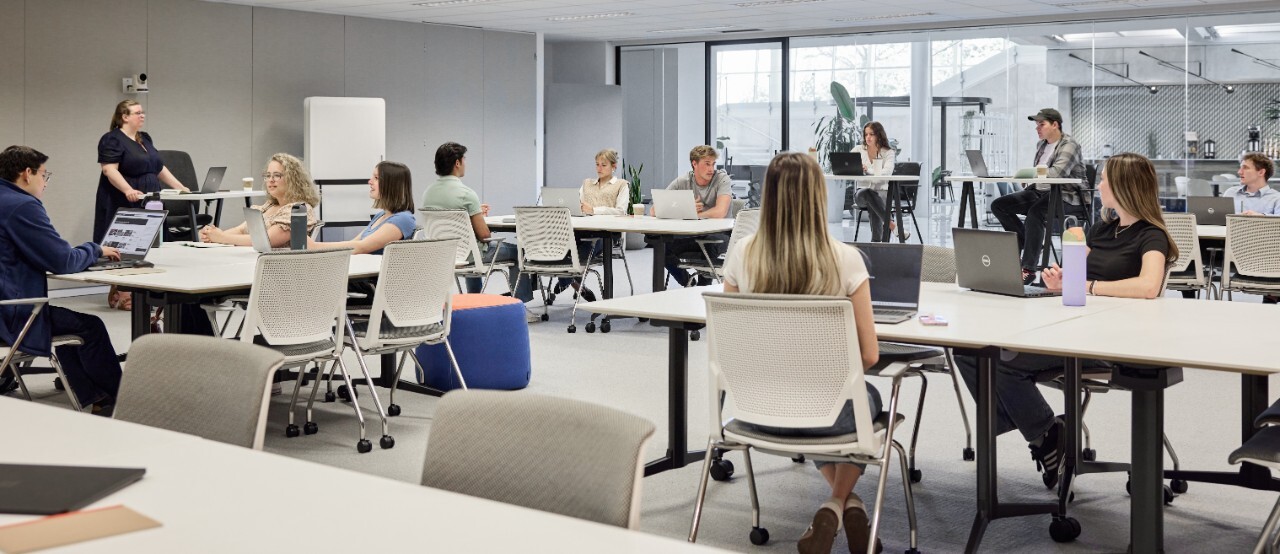
The case for active learning is strong enough now that it functions as a spec requirement. A widely cited meta-analysis of 225 studies by Freeman et al. (2014), published in PNAS, found students in active learning courses scored roughly 6% higher on exams and were about 1.5 times less likely to fail than students in traditional lectures.
That matters for the room itself. Active learning needs furniture that lets students face each other, break into groups, and shift between solo focus and teamwork inside one class period. Fixed rows built for passive lecture can't do that. Neither can furniture spec'd for just one teaching mode.
So the real brief for a future-ready classroom isn't "fit the projector." It's "let the instructor teach however this discipline evolves over the next fifteen years." That's doable, but only with furniture that moves, reconfigures, and connects, plus an infrastructure plan that clearly separates what stays fixed from what stays flexible.
Power and Data: The Variables That Age Fastest
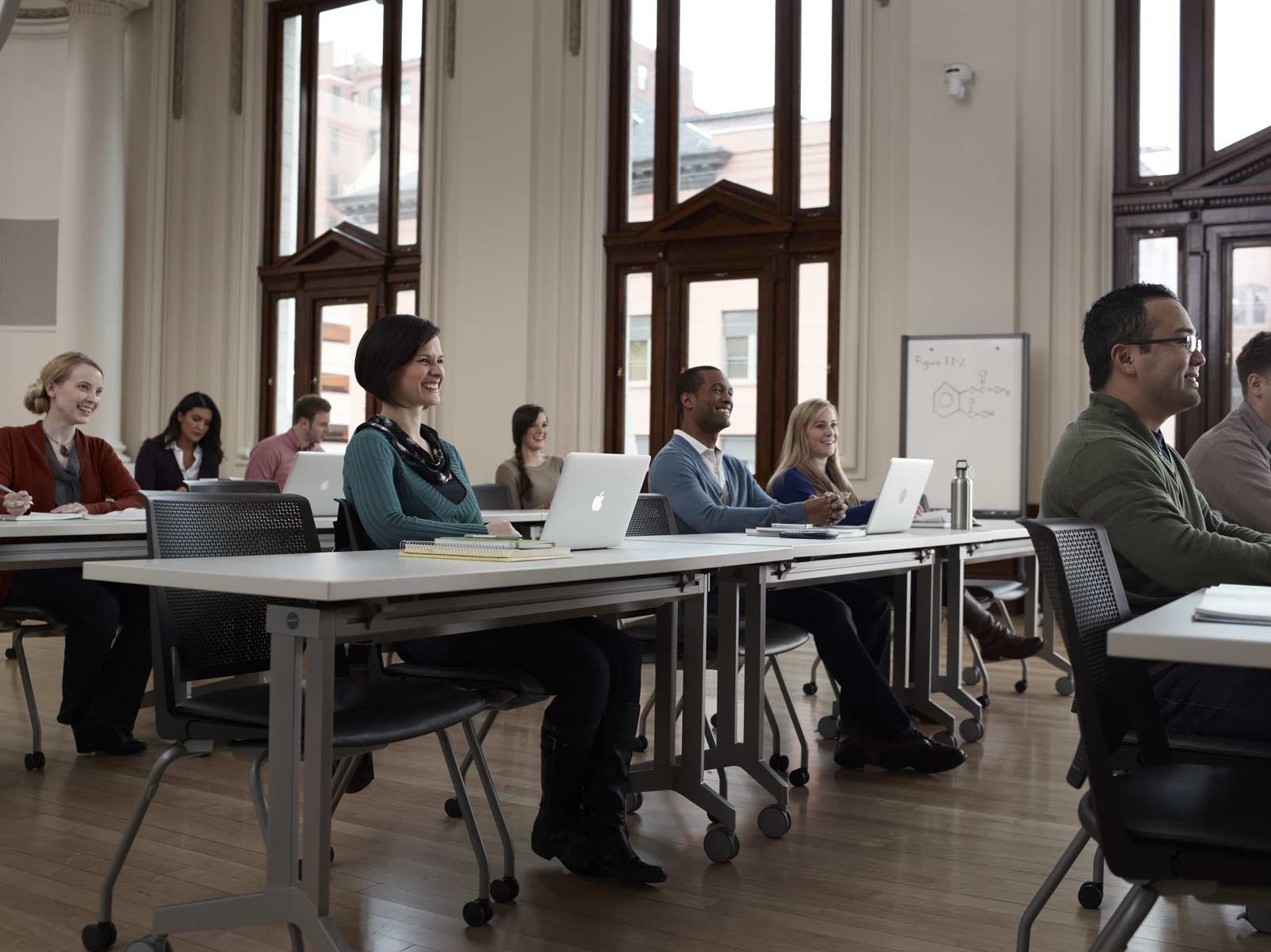
Power is where future-proofing takes the most deliberate planning. The EDUCAUSE 2025 Horizon Report names AI-powered learning tools, spatial computing, and distributed collaborative tech as near-term developments, and every one of them pushes power demand higher at the student's seat. Installing four-outlet floor boxes for today's power demands likely won't cover what's needed by 2030.
The better approach spreads power through the furniture, not just the floor. Tables with integrated power modules that can be upgraded or moved let a school adapt without breaking ground. This doesn't replace solid floor infrastructure. It adds a layer of flexibility that fixed infrastructure alone can't give you.
The trick is keeping replacement cycles separate. The table, the cable management, and the furniture's power distribution should run on a different lifespan than the tech it hosts: the outlets, the USB-C ports, the wireless charging that evolve with people's devices. Get that separation right, and you can refresh the tech without touching the furniture.
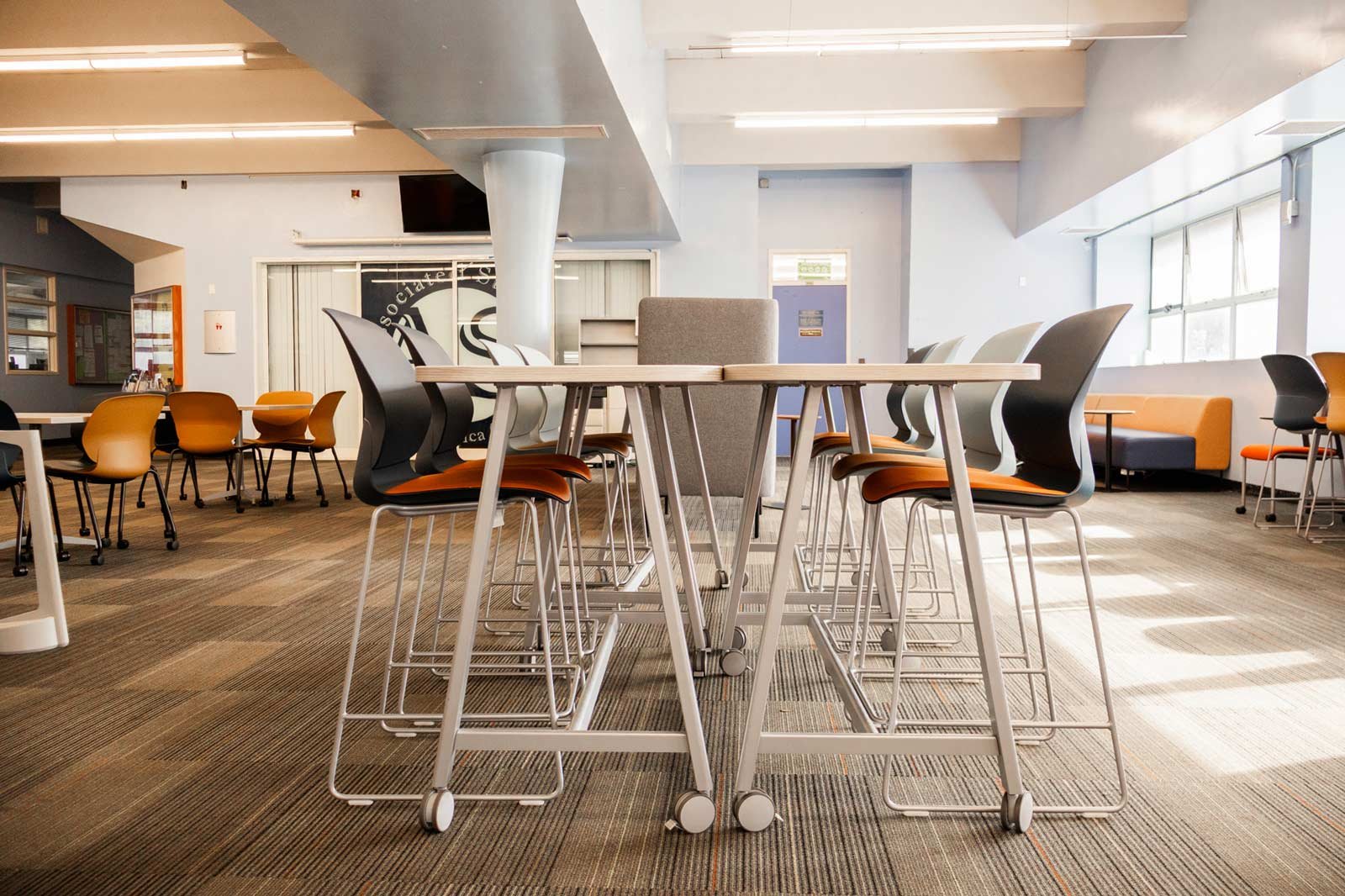
Santa Monica College, Office of Student Life
Build Reconfigurability In From the Start
The classrooms that have held up best across multiple tech cycles all share one thing: movement was a design requirement from day one, not something people hoped would work out after install. Tables that nest, stack, and reconfigure in under five minutes, no tools needed, let one room work as a lecture hall, a seminar space, a collaborative studio, and an exam room: same furniture, just arranged differently.
The details that actually decide whether a room reconfigures in real life are the ones procurement tends to skip:
- Caster quality decides whether furniture actually rolls, or just claims to on a spec sheet.
- Table weight decides whether students and faculty can reset the room themselves, or whether every format change needs a facilities crew.
- Nesting and stacking dimensions decide whether a sixty-person lecture hall can turn into a ten-person seminar without a dedicated storage room.
We spec these details explicitly on our higher ed projects, because the gap between furniture that reconfigures in the room and furniture that only reconfigures in the showroom lives in details that never make it into a product photo. A classroom spec'd with real reconfigurability criteria will serve multiple teaching styles across two or three tech cycles.
Integrating With the Campus Hybrid Plan
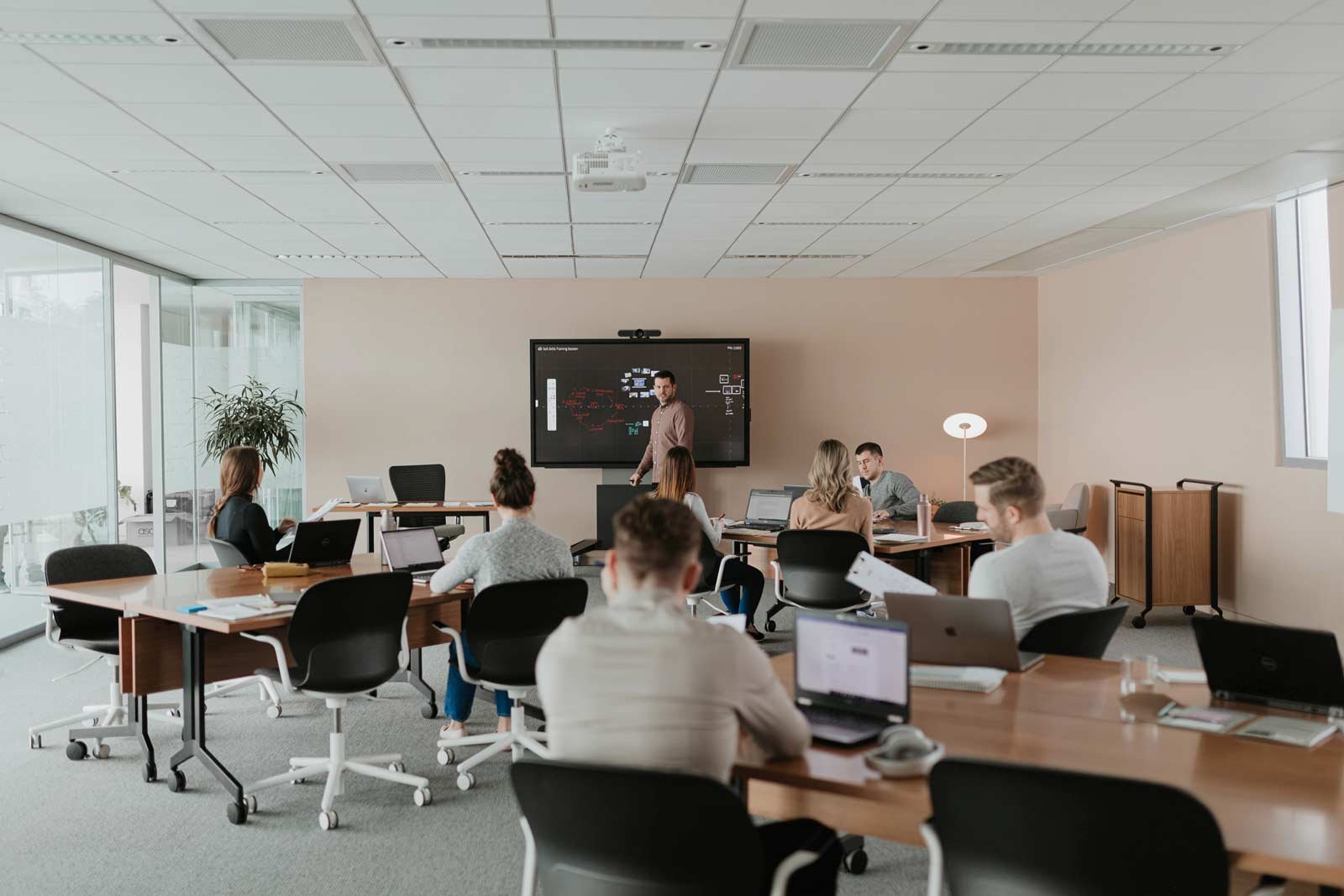
Hybrid teaching, some students in the room, others remote, creates a coordination problem that furniture has to plan for, not just react to. Gensler's 2025 Global Workplace Survey found tech frustration is one of the top reasons people avoid shared spaces, and the same thing plays out on campus: hybrid tech that fails degrades the experience for remote students and tells faculty the room isn't worth teaching in.
In hybrid-capable rooms, furniture and AV need to be planned together. Camera sightlines can't get blocked by table edges or display gear. Mic pickup zones have to work even after furniture gets rearranged. Displays need to be positioned so both in-person and remote participants can see shared content without needing a perfectly aligned room. These look like AV problems. They're actually furniture-positioning problems, and they get solved when both specs happen in the same conversation.
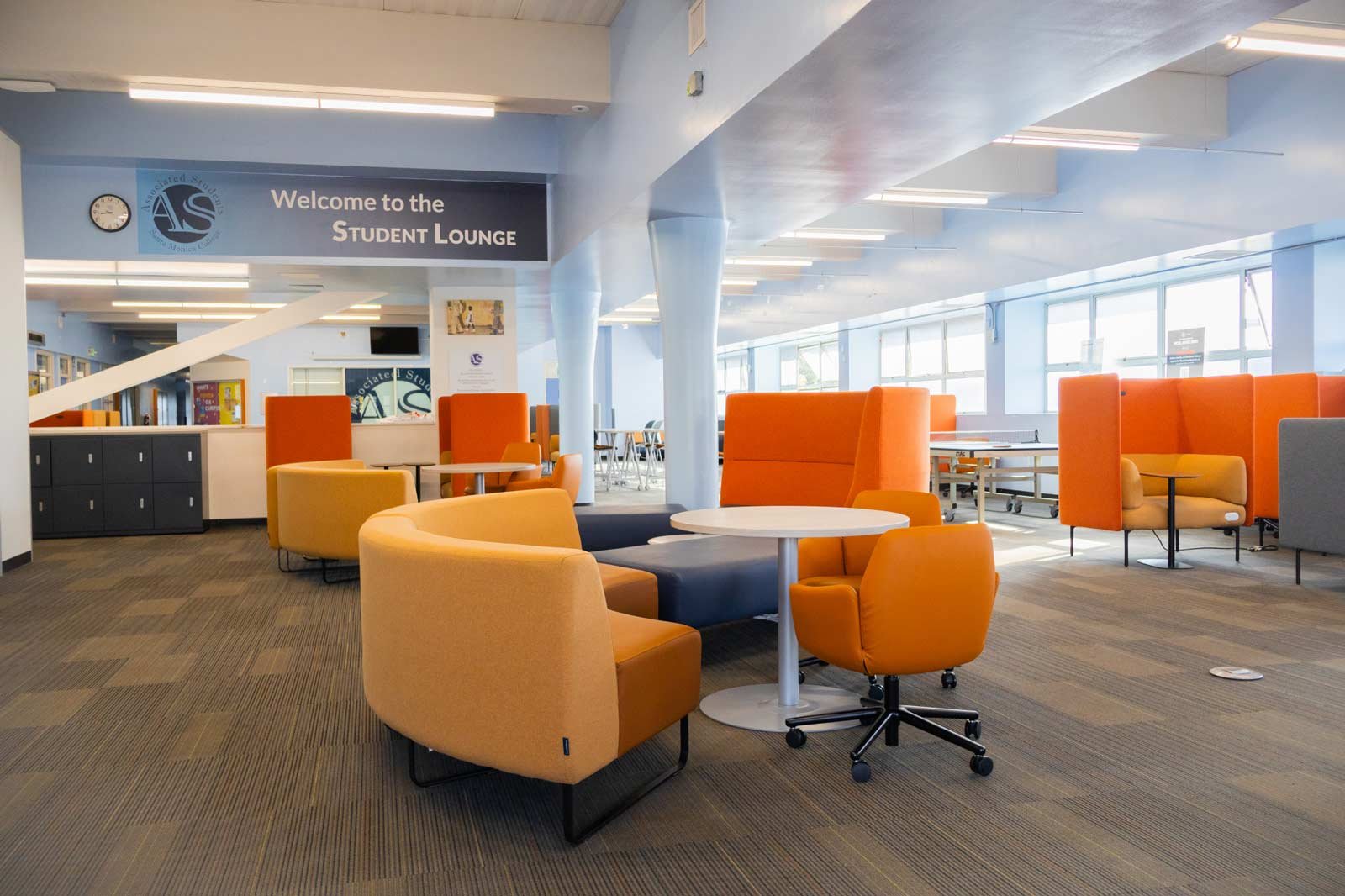
Santa Monica College, Office of Student Life
How We Approach the Higher Education Spec
We plan these spaces around one core separation: durable furniture infrastructure on one cycle, swappable technology on another.
In practice, that means specifying Haworth's mobile, flip-top, and nesting table systems and reconfigurable seating, where movement and storage flexibility carry the room across teaching modes. It means integrated, relocatable power at the table instead of betting everything on the floor. And because no single manufacturer covers every active-learning scenario, we source across more than 300 lines to match the right reconfigurable system to each room's teaching style and budget.
When a room needs something the catalog doesn't have (a power-integrated collaborative table sized for an unusual space, casework that has to line up with a specific AV layout), we build it through Platform, our in-house custom furniture brand. The goal is always the same: furniture that stays useful long after this generation of technology is gone.
The Takeaway
Future-proofing a classroom isn't about predicting the next technology. It's about specifying furniture that doesn't care which technology shows up: furniture that moves, carries its own power, and reconfigures around whatever faculty need to teach. Done well, it's the quietest line item in the budget, and the one that pays off the longest.
Ready to Build Future-Ready Learning Spaces?
Let's plan classrooms that serve your faculty and students across the next several technology cycles, not just this one. Contact our higher education team to learn how the right furniture strategy keeps your spaces current.