

Healthcare organizations understand the patient experience with extraordinary precision. They map the care journey, audit the waiting room, and invest in calming materials palettes and wayfinding systems. But the people making that experience possible, nurses logging twelve-hour shifts, physicians moving between exam rooms, care teams charting in hallways, are often working in environments that have never been designed with their needs at the center.
That gap is not sustainable.
A significant body of research on healthcare workplace design identifies the physical environment as an underutilized lever for addressing the staffing crisis reshaping the industry. The economic case is not abstract: when 30% of employees who indicate intent to leave actually do so within the year, and when every one-percent increase in registered nurse turnover costs the average hospital $262,500 annually, the logic for investing in caregiver environments becomes difficult to ignore.
The framework below covers four distinct zones: the clinical workstation, the point-of-care corridor, the team collaboration hub, and the respite space. It draws on research into caregiver burnout and resilience, ergonomics and safety, and the science of restorative design. The full research is available for download.
Why the Built Environment Belongs in the Retention Conversation
Healthcare worker burnout is not primarily a personal problem. Research identifies three key influence systems driving it: systemic issues like staffing shortages, personal factors like loss of self-care, and the local environment, including physical space, communication barriers, and workflow design. Of the three, the physical environment is the one facilities managers and design teams can actually change.
The data on what happens when that environment is neglected is striking. Staff in rooms without access to natural light or a view are measurably more stressed, 18% more so by end of shift, 26% more emotionally exhausted, and experience 40% higher rates of depersonalization compared to colleagues in more supportive settings. Noise at caregivers' workstations, where 20 to 38% of clinical communication occurs, directly impairs cognition and contributes to medical errors. Work-related injuries and illnesses in U.S. hospitals are recorded at twice the rate of the private industry average, a figure that points directly to inadequate ergonomic support.
Caregiver needs beyond salary and benefits, including pride in their organization, feeling safe at work, feeling supported by leadership, and a sense of belonging, are shaped significantly by the quality of the environments in which they work. Sixty percent of the items that drive caregiver retention also drive engagement. Ninety percent of the items that drive physician retention do the same. Physical workspace quality is not peripheral to this equation; it is embedded in it.
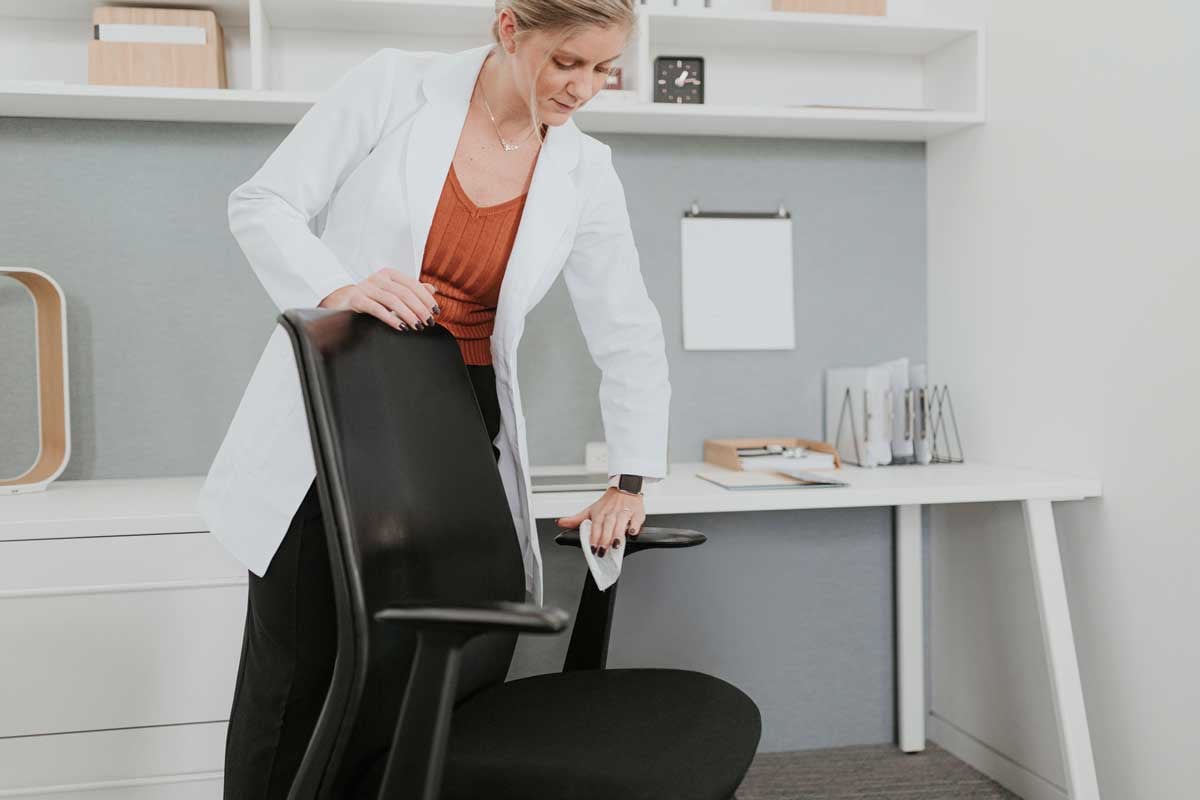
Haworth Soji Cleanable+ Office Chair
Zone 1: The Clinical Workstation — Ergonomics as Patient Safety
This framework distinguishes between onstage spaces, where caregivers interface directly with patients during consultations, wellness checks, and emergency services, and offstage spaces, where non-patient-facing work is done. Nurses' stations, documentation zones, and care team workstations are primarily offstage. But what happens in them directly determines what is possible onstage.
The ergonomic stakes are well documented: workflow inefficiency, low-performance workspaces, and safety concerns rank among the top caregiver pain points. With healthcare workers experiencing musculoskeletal injuries at twice the private industry rate, task seating at clinical workstations is a safety specification, not a comfort preference. And in environments where infection control is a daily priority, the ability to disinfect that seating with healthcare-grade protocols is a non-negotiable functional requirement.
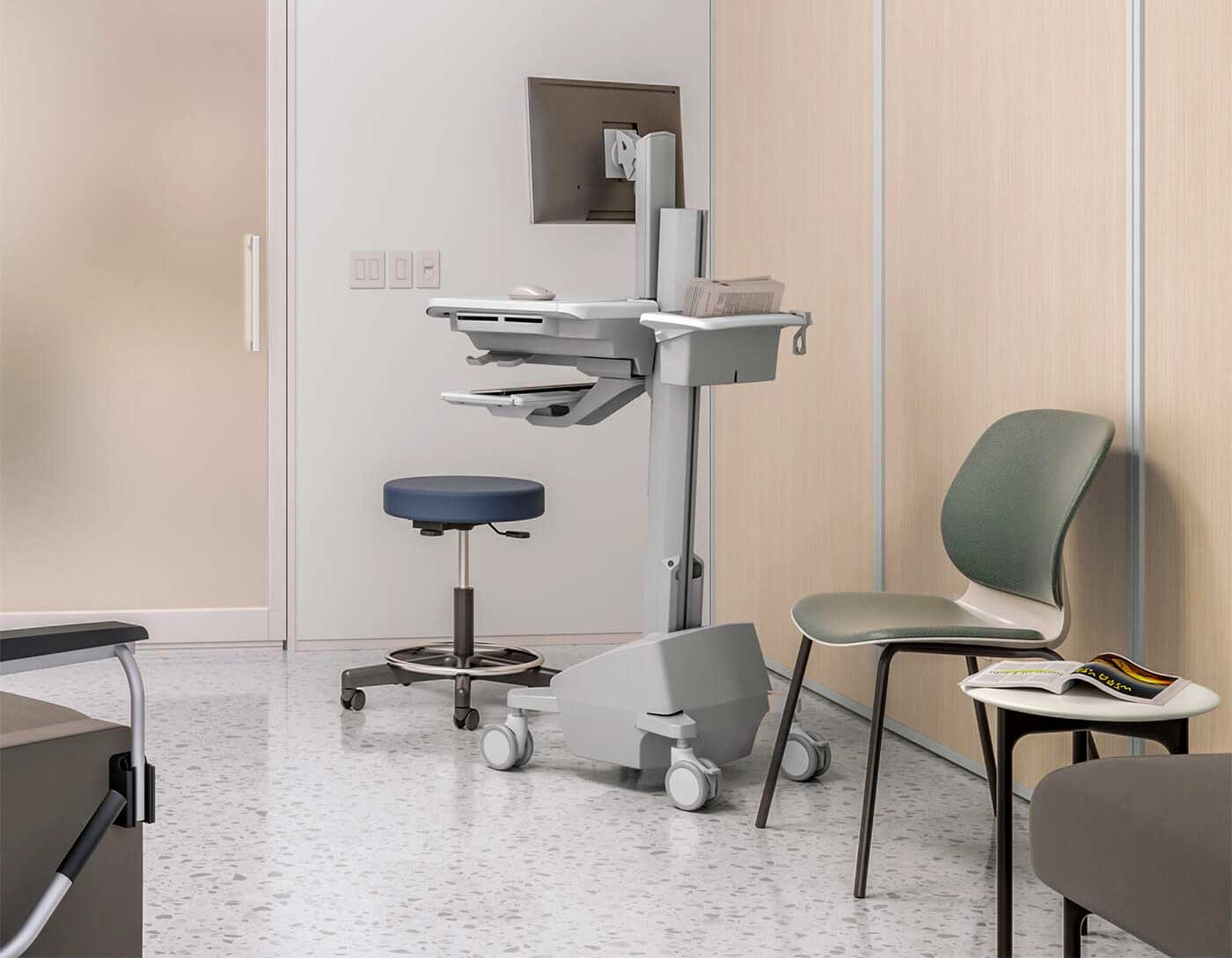
Ergotron CareFit Slim 2.0 LCD Cart
Zone 2: The Point-of-Care Corridor — Technology That Moves With the Clinician
Research into caregiver workflow introduces a concept called the Triangle of Patientricy: the simultaneous management of patient interaction, technology access, and clinical workflow that defines the modern care encounter. The stakes are real. When caregivers are fatigued or distracted, they can input incorrect codes, miss critical information, or fail to fully connect with the patient in front of them. Four out of five healthcare employees want to learn more about how to use AI tools in their profession, and technology integration is accelerating. The furniture and equipment that mediates the clinician's relationship with technology is not incidental to care quality.
In the corridor and at the bedside, the mobile workstation is the primary vehicle for that mediation. Spaces that can be easily reconfigured or upgraded with new technologies are essential to futureproofing healthcare environments, and the mobile cart, which can be redeployed rather than replaced, is one of the most cost-effective expressions of that principle. The design challenge is not simply function, but lean efficiency: carts that are too bulky reduce corridor safety, waste caregiver time, and fail in the confined geometries of patient rooms and clinical alcoves.
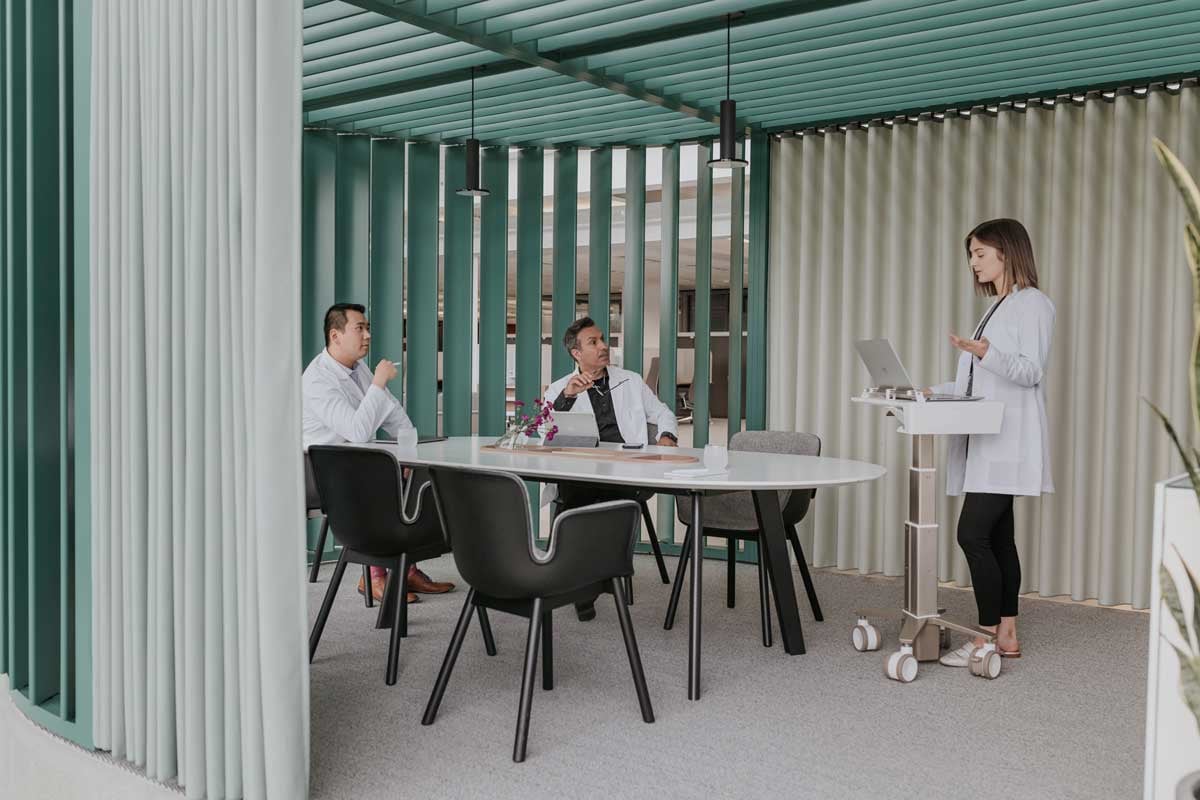
Zone 3: The Collaboration Hub — Designing for How Care Teams Actually Communicate
Here is a striking finding from the research: 30% of clinical communication takes place while walking in corridors, while another 20 to 38% occurs at caregivers' workstations. A substantial portion of the communication that drives care quality, including team huddles, clinical handoffs, and rapid consultations, is happening in spaces that were never designed for it.
Effective collaboration environments need to support four distinct modes:
-
Connect Spaces for face-to-face interaction and informal gatherings
-
Inform Spaces for clinical process training and multi-way communications
-
Think Spaces for team interaction and new process discovery
-
Do Spaces for specific and time-sensitive tasks
Most healthcare facilities support one or two of these modes adequately. Few support all four. The result is communication that defaults to the corridor, and the care coordination failures that follow.
The clinical case for investment here is also clear: teamwork reduces the number of medical errors, increases patient safety, and helps patients and families feel more at ease. The design response is not complicated; it is, however, deliberate, and it requires architectural thinking that can respond to departmental change without the cost and disruption of construction.
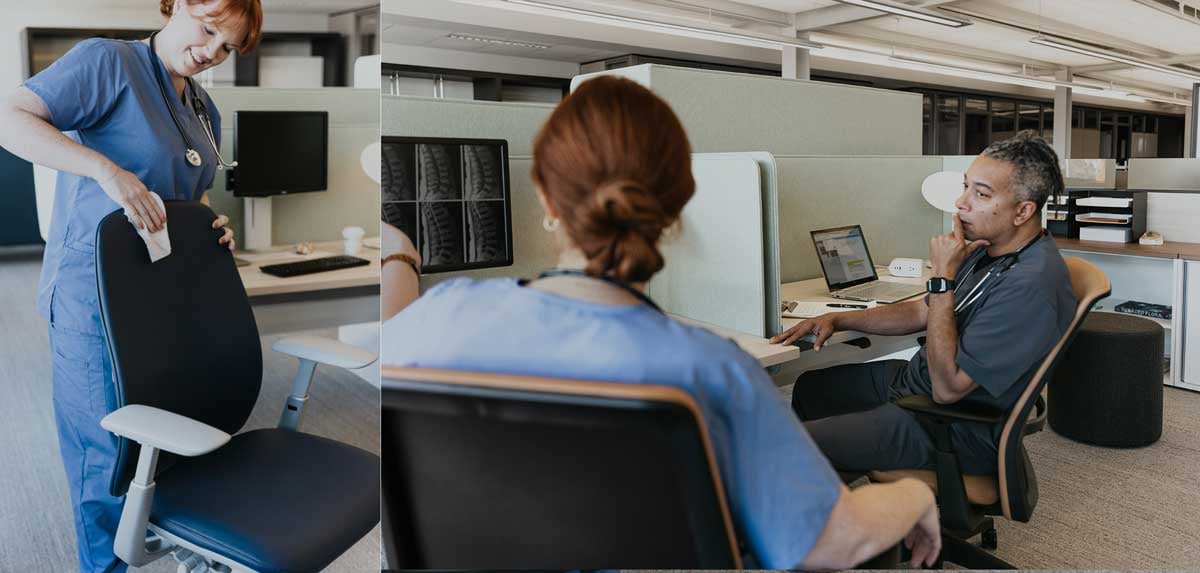
Haworth Zody LX Cleanable Task Chair
Zone 4: The Respite Space — Recovery as a Clinical Design Priority
Burnout is largely caused by environments and by how people operate within them. The inverse is equally true: the environment's design can prevent or reverse it. Dedicated areas for respite and refuge encourage staff to step away from care-facing zones, decompress, and return with restored capacity. These are not luxury amenities; they are operational infrastructure.
Restorative spaces require a specific set of conditions: comfortable furniture that signals genuine rest and recovery, acoustics that reduce the concentrated noise of clinical environments, biophilic elements that engage the well-documented stress-reduction benefits of nature, and intentional separation from patient-facing aesthetics. The Cleveland Clinic's Lavender Lounge, a staff respite space incorporating a recliner, massage chair, beanbag, and aromatherapy, illustrates the principle well. It exists to give caregivers, including those processing grief or emotional distress, a private moment to recover before returning to the floor.
For facilities managers, the specification logic is straightforward. Restorative seating in these spaces must communicate a fundamentally different register than the task chairs of clinical workstations. It must allow full physical decompression, and it must be durable enough to withstand the round-the-clock use patterns of multi-shift environments.
The Operational Case for Caregiver-Centered Design
This framework is a starting point for a more rigorous conversation about what it means to treat caregiver environments with the same intentionality currently directed at patient-facing spaces.
Each of the four zones has distinct functional requirements. Each responds to a documented caregiver need that the physical environment can either support or undermine. And each offers facilities managers and design teams a concrete, specifiable path forward that connects product decisions to measurable operational outcomes.
The research is consistent on one point above all: the items driving caregiver retention and the items driving caregiver engagement are largely the same. Investment in the physical environment is not a choice between culture and productivity. It is the infrastructure through which both are built.
Partner with Unisource Solutions for you healthcare facilities needs
Whether you are planning a new outpatient facility, refreshing a clinical workstation environment, addressing a burnout-driven retention challenge, or designing a respite program from the ground up, our team offers design consultation grounded in research and delivered at the pace healthcare projects require.