

The return-to-office conversation has evolved beyond policy debates into a spatial design challenge. Organizations mandating increased in-office presence, whether full-time or structured hybrid, are discovering that requiring attendance doesn't automatically rebuild culture or collaboration. The reason is straightforward: the physical workplace must offer experiences that home environments cannot replicate, or employees will show up without truly engaging.
Employees in high-performing workplaces spend significantly more time collaborating than those in low-performing environments, but that collaboration advantage only manifests when the physical space actively supports it. Organizations with RTO mandates but unrenovated pre-pandemic offices are experiencing what workplace strategists call "presence without productivity", which is bodies in chairs without the engagement, serendipity, and innovation that justified the return.
This article examines the design frameworks that transform return-to-office from a mandate to a competitive advantage and how to create environments where in-person work is genuinely preferable to remote alternatives.
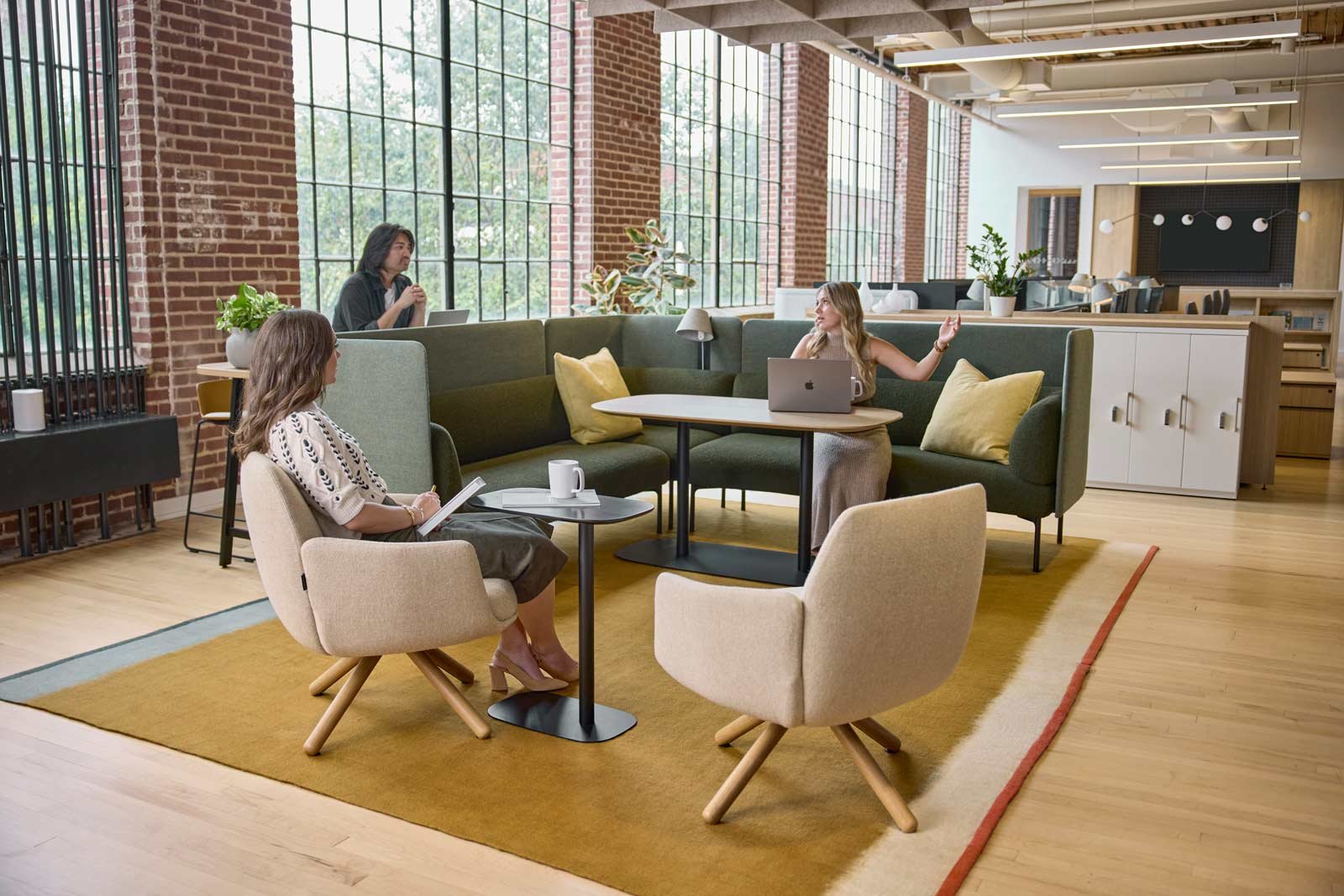
The Commute Equation: Understanding Employee Cost-Benefit Analysis
Remote work didn't just prove possible during the pandemic, it enabled employees to optimize their personal work environments in ways most offices haven't matched. Knowledge workers at home have controlled their acoustic environment, eliminated commute friction, integrated personal and professional schedules, and customized their physical setup to individual ergonomic preferences. Returning to the office asks them to sacrifice these optimizations.
The typical commute represents a significant daily investment, not just in travel time but also in the mental transition, schedule rigidity, and personal convenience that employees give up. This creates a considerable gap that the workplace must overcome through differentiated offerings. The question isn't whether employees will return—mandates can compel physical presence—but whether returning produces the collaborative, cultural, and innovative benefits that justify organizational investment in office space.
For design teams, this framing transforms the brief. The goal isn't about creating an adequate workspace; it's about creating experiences that are human-centered and unavailable elsewhere. Every design decision should answer the question: Does this make in-person work materially better than the remote alternative?
Collaboration Infrastructure: Beyond Meeting Rooms
The collaboration advantage of in-person work is real but not automatic. Video conferencing has proven adequate for structured meetings; the kind with agendas, predetermined participants, and defined outcomes. The office's irreplaceable value lies in unstructured collaboration: spontaneous encounters, hallway conversations, visible working that enables mutual assistance, and the informal social bonding that builds organizational trust.
One key predictor of workplace innovation is what designers call "collision density", that is, the frequency of unplanned encounters between people who don't typically work together. The more spontaneous interactions, the more ideas cross-pollinate. Traditional office layouts, designed around departmental groupings and enclosed meeting rooms, often prioritize efficiency over spontaneous interaction. RTO-focused design deliberately engineers collision through circulation patterns that cross team boundaries, shared amenity destinations, and social spaces positioned at high-traffic intersections.
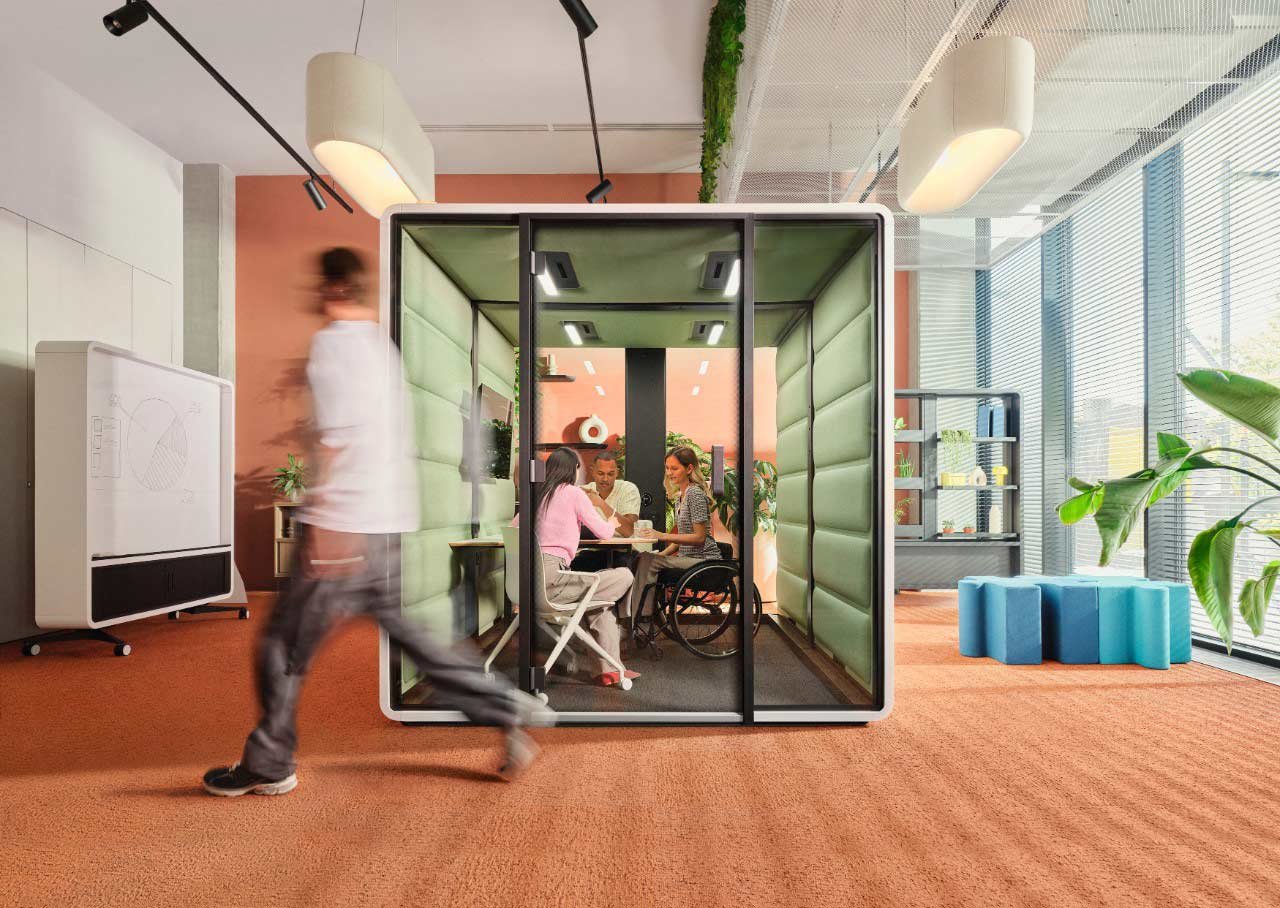
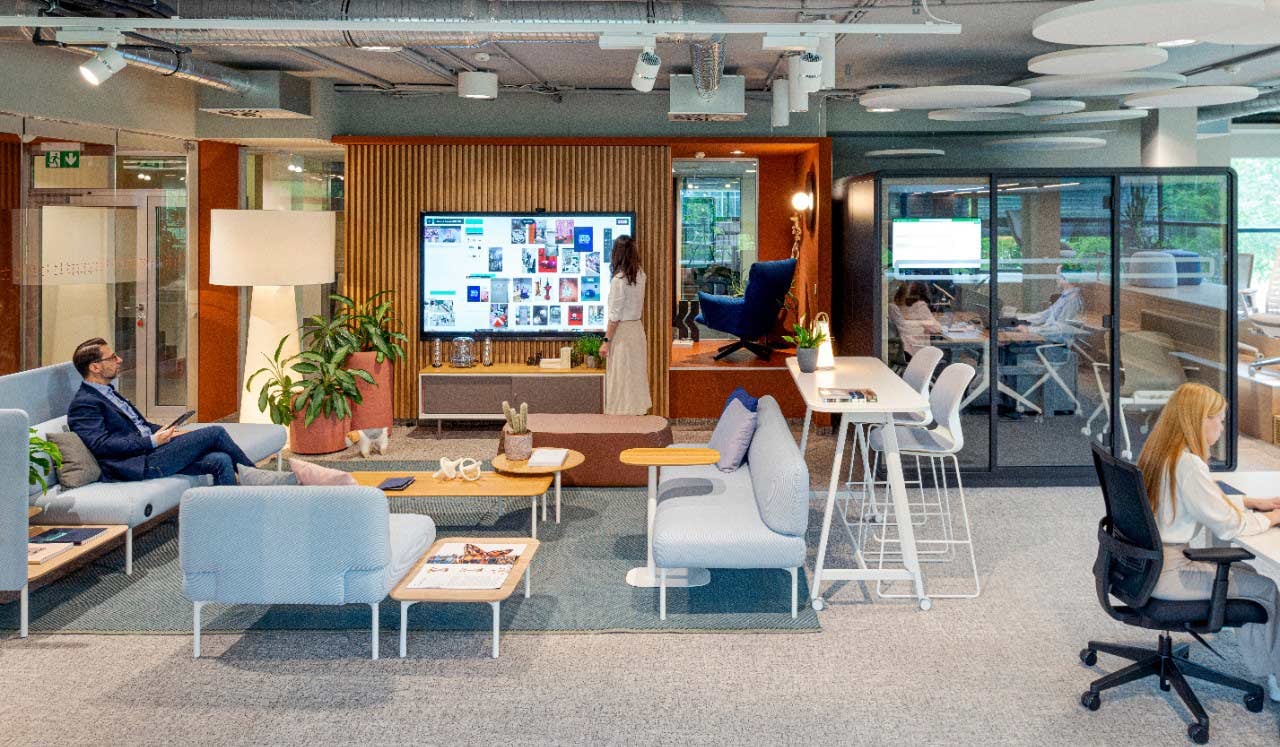
Collaboration zones in RTO environments require different furniture configurations than pre-pandemic equivalents. Teams accustomed to remote whiteboarding need writable surfaces, digital capture capabilities, and layouts that accommodate both in-room and remote participants simultaneously. Furniture systems that reconfigure rapidly between huddle, workshop, and presentation modes support the varied collaboration types that justify in-person gathering.
We specify collaboration furniture based on how teams actually work, understanding the specific collaborative activities each organization prioritizes and designing settings that make those activities better than their virtual equivalents. For a technology company focused on design sprints, this might emphasize reconfigurable workshop spaces with extensive vertical display surfaces. For a financial services firm prioritizing client relationship building, the focus shifts to hospitality-quality meeting environments that project organizational credibility.

Focus Environment Excellence: Competing with Home
Counterintuitively, one of the strongest arguments for office-based work is focus quality. Many employees struggle to concentrate at home, with children, roommates, domestic maintenance, and the cognitive load of managing personal space during professional work all compromise deep attention. A well-designed office can offer professional-grade focus environments unavailable in residential settings.
The catch: most offices don't. Open-plan layouts prioritizing visual supervision and easy communication produce acoustic environments that can be worse than home for concentrated work. Post-occupancy studies consistently identify noise, particularly phone and video call audio, as the primary workplace complaint. RTO design must address acoustics comprehensively or forfeit the focus advantage entirely.
Our acoustic design approach stratifies the workplace into zones with distinct sound profiles: library-quiet areas where conversation is prohibited and even phone calls must be taken elsewhere; team neighborhoods with moderate acoustic treatment supporting group interaction; café zones where ambient activity is expected; and enclosed phone rooms and focus pods providing acoustic isolation within open floor plates.
Furniture specification for focus environments prioritizes acoustic absorption (high-backed seating, panel systems with sound-dampening materials), visual enclosure (screens and dividers that reduce peripheral distraction), and ergonomic excellence (height-adjustable desking, task chairs that surpass home alternatives). When the office focus environment is demonstrably superior to home, employees have rational reasons to commute for deep work, not just meetings.
Hospitality Principles: Experience as Strategy
The destination office concept imports hospitality design principles into workplace environments, recognizing that the office must create experiences, not just provide facilities. Hotels succeed by anticipating and exceeding guest expectations; offices must apply similar thinking to employee experience.
Arrival sequence matters. The transition from street to workspace establishes psychological context for the workday. High-performing RTO environments design arrival experiences that provide orientation, social connection, and decompression, with entry lobbies that feel welcoming rather than surveilling, coat storage and personal prep areas that manage the commute-to-work transition, and café or social spaces that enable daily reconnection before diving into tasks.
Amenity investment signals organizational values. Employees evaluate whether their employer values their presence through tangible environmental evidence. Quality food and beverage service, not vending machines and sad break rooms, shows you value your people's daily experience. Fitness facilities, outdoor spaces, and wellness rooms acknowledge that employees are whole people with needs beyond task completion. These aren't perks in the HR-benefits sense; they're infrastructure that makes full-day office presence sustainable and even attractive.
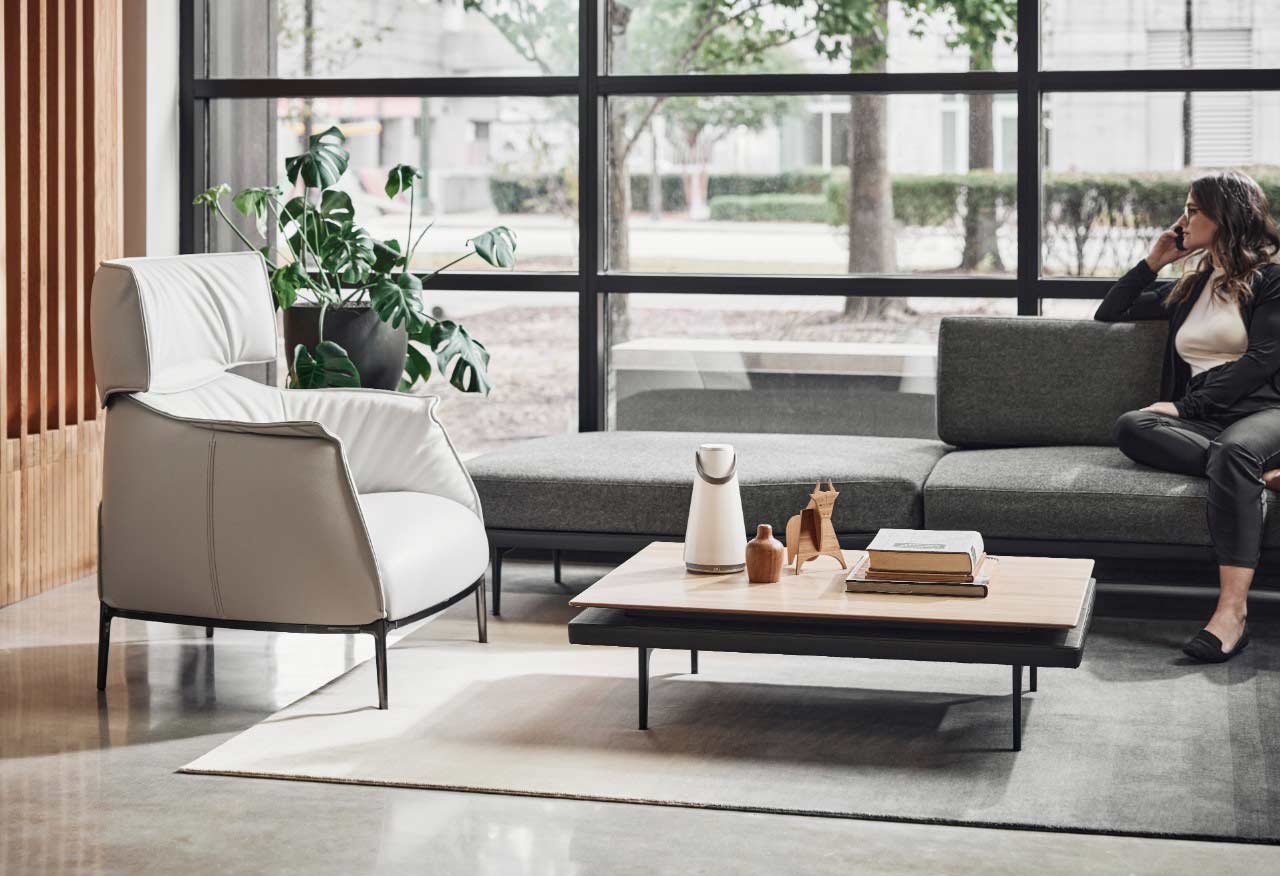
Our hospitality-focused specifications draw on residential furniture quality, hotel-grade soft seating, and custom millwork that creates identity and warmth impossible with standard commercial products. Our Platform custom division allows us to design pieces that respond to specific organizational cultures and spatial constraints, with branding elements, reception experiences, and signature gathering spaces that distinguish clients' workplaces from generic corporate interiors.
Technology Integration: Removing Friction
Remote work succeeds partly through reduced friction, with no commute, immediate access to tools, and personal control over the environment. RTO environments must match this low-friction standard, or employees will perceive in-office work as productivity drain.
Technology friction manifests in familiar frustrations: meeting rooms where AV never works reliably, desk booking systems that require five minutes of app navigation, power access that requires cable management archaeology, and network connectivity that mysteriously fails at important moments. Each friction point subtracts from the office value proposition.
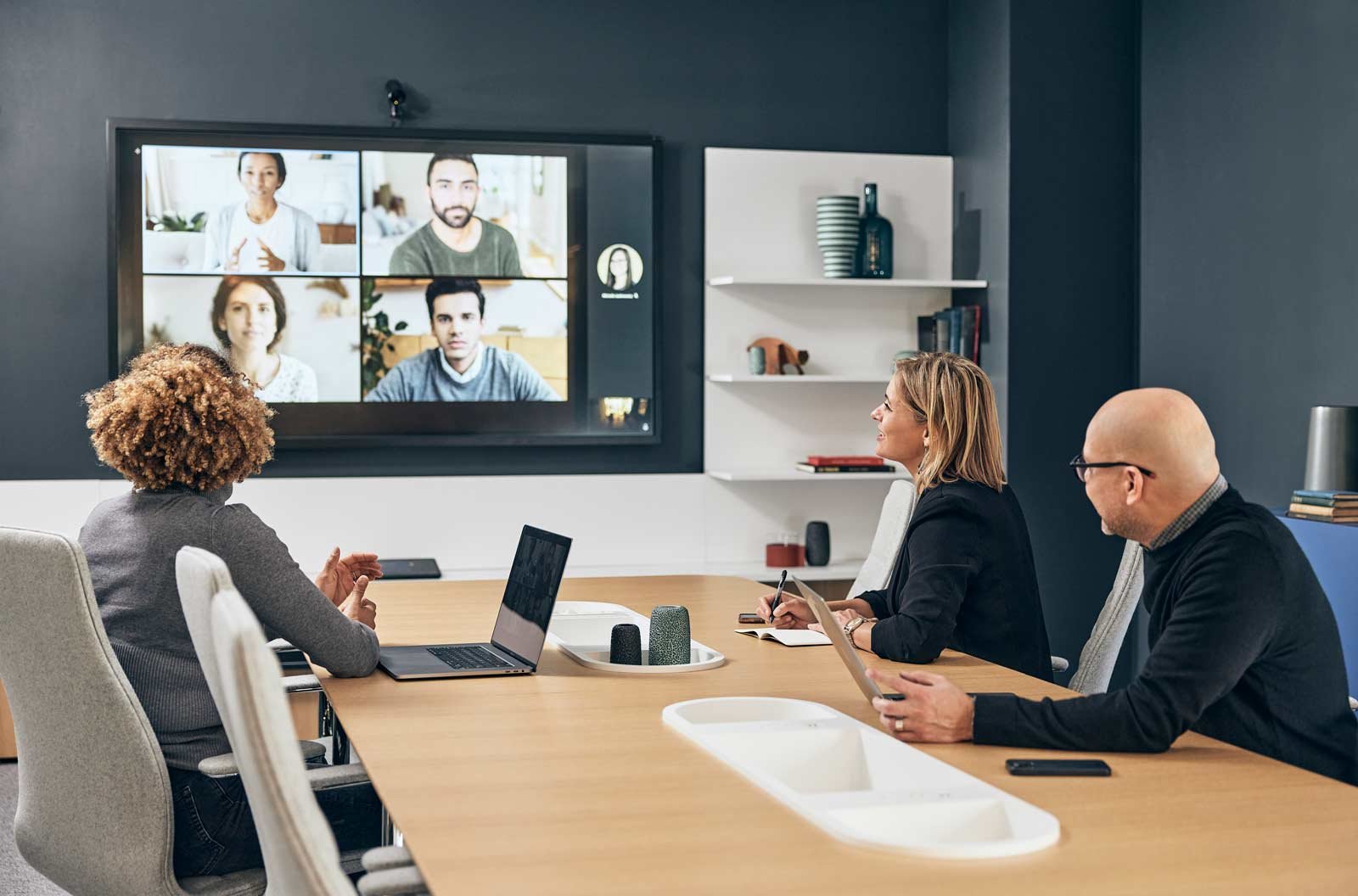
Furniture specification increasingly includes technology integration requirements. Meeting tables need cable management that accommodates one-touch video conferencing without visible wire chaos. Desking systems require power and data delivery that works immediately without IT intervention. Collaborative zones need display surfaces that connect seamlessly to both in-room and remote participants. The standard isn't meeting expectations; it's exceeding what employees have achieved at home.
We evaluate furniture systems partly on technology integration sophistication, including features like wireless charging surfaces, integrated power distribution, and cable-free connectivity options that eliminate the infrastructure barriers to workplace flexibility. The goal is invisible technology: systems that enable productivity without requiring attention or generating frustration.
Making the Investment Case
Workplace improvement for RTO requires capital investment at a time when many organizations are questioning real estate budgets. The business case rests on comparing renovation costs against the costs of unsuccessful RTO: elevated turnover among employees who leave for more flexible competitors, recruitment challenges when workplace quality becomes known, productivity losses from disengaged compliance, and the strategic cost of failing to achieve the collaboration and culture benefits that motivated RTO in the first place.
Workplace quality influences job satisfaction independently of salary, benefits, or job duties, and job satisfaction directly impacts retention. For organizations facing tight labor markets, the workplace becomes a competitive differentiator. The question isn't whether workspace investment produces returns; it's whether the returns exceed alternative uses of capital.
We support investment decisions through space utilization analysis, employee experience benchmarking, and total cost of ownership modeling that frames workplace spending as productivity infrastructure rather than overhead expense. For organizations where RTO success is strategically important, the analysis typically favors investment levels that would seem excessive if the workplace were viewed merely as a place to house workers.
From Mandate to Competitive Advantage
The organizations achieving successful return-to-office have reframed the challenge. Rather than asking how to compel attendance, they're asking how to create environments where employees want to be, and where in-person presence produces outcomes unavailable through remote work. This requires investment, intentionality, and design expertise that bridges organizational strategy and spatial experience.
We support RTO design strategies through workplace assessment, programming research, manufacturer-agnostic specification, and implementation coordination that ensures design intent translates to operational reality. Whether you're planning comprehensive renovation, targeted improvements to high-impact zones, or phased approaches that build momentum through demonstrated wins, we bring cross-sector experience and research-grounded frameworks to the challenge of creating workplaces worth returning to.
Ready to transform your return-to-office strategy through workplace design?
Contact our team at Unisource Solutions to schedule a strategic consultation.